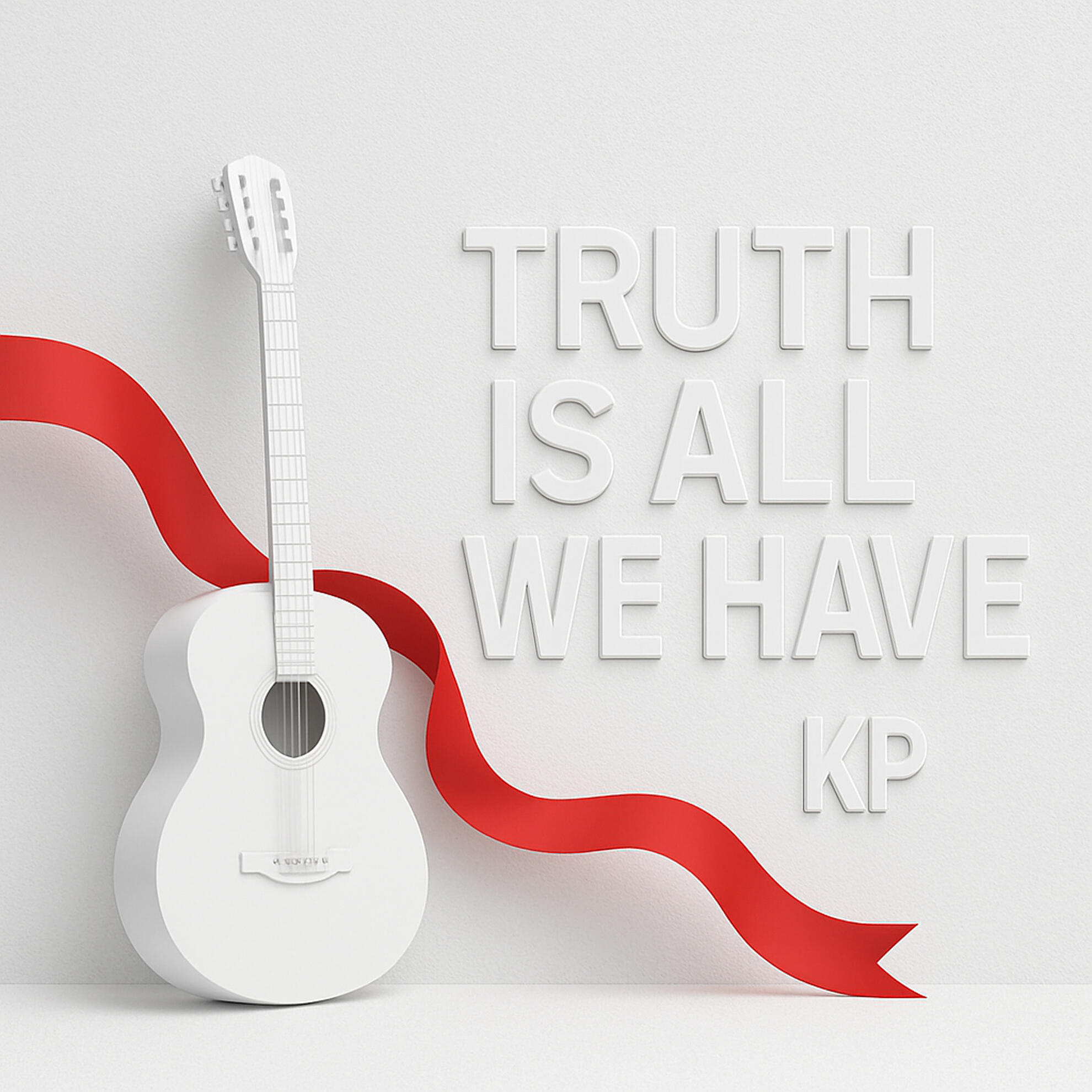
TRUTH IS ALL WE HAVE
A music project by KP merging Physics, Philosophy & Poetry.
First, I tried writing.....
For a long time, I believed that if an idea was true enough, it would eventually submit to language — that with enough clarity, discipline, and structure, it could be explained cleanly. It didn’t. Every attempt to flatten what I was seeing into words collapsed too early, forcing certainty where there was only tension.Music turned out to be the only medium patient enough to hold that tension without demanding resolution. Truth Is All We Have emerged from that refusal to explain — as a space where physics, philosophy, and poetry could coexist long enough for something honest to be felt.
The Thread that Binds all Paths

This track began with a discomfort I couldn’t reason my way out of — the sense that no matter how much effort or intention I applied, outcomes refused to obey. The more I tried to hold on to control, the more fragile my explanations became.
What slowly replaced that resistance was not clarity, but constraint. The realisation that events do not stand alone, that every moment arrives carrying the weight of countless others. That what we experience as choice sits inside a much larger weave of causes, probabilities, and limits.
The song doesn’t argue with this. It lets the argument collapse. What remains is not despair, but alignment — a quieter acceptance that while control may be an illusion, participation is not. We still contribute. We still move. We still matter, even when outcomes are not ours to command.
This is where the album begins: not with answers, but with the thread that makes all paths intelligible at once.
The Two Voices

Once the illusion of control loosens, another question appears: how does movement still happen at all?This track lives inside that question. It doesn’t treat doubt and hope as opposites, or as forces that need resolving. Instead, it lets them stand side by side — one urging restraint, the other insisting on flight. Both are right. Both are necessary.The song was written at a moment when action felt unreasonable, when the sensible path pointed toward staying put while another voice, less articulate but more insistent, asked to move anyway. What surprised me was not the presence of these voices, but the way they depended on each other. Doubt tests whether a dream can survive contact with reality. Hope supplies the energy to attempt that contact in the first place.The track doesn’t resolve the tension between them. It lets the grey remain — until it gathers enough force to become motion. Not certainty, not confidence, but readiness. The album moves forward here not by silencing either voice, but by carrying both.
Who am I?

This track was recorded last, even though it was written first.Every attempt to stabilise the self — through belief, achievement, memory, or aspiration — seemed to thin out the moment it was examined. Identity didn’t collapse under pressure; it dissolved when attention lingered too long.What unsettled me wasn’t the absence of meaning, but the impossibility of thinking without something that endures. Every event demanded a subject. Every change implied a persistence. Even when trying to understand the universe, or God, I found myself searching for a face — a form that would survive movement and make loss intelligible.The song doesn’t reject identity. It exposes the dependency on it. The need for a stable “I” is not a flaw; it is a requirement of how humans reason. When that requirement is set aside, even briefly, what remains is not emptiness, but motion — events looping without a centre, coherence without a name.This track doesn’t answer the question it asks. It lets the question exhaust its own assumptions, and then moves on
Just Running

After identity loosens, movement doesn’t stop.
Messages still arrive. Clocks still tick. Even moments that resemble rest carry the background hum of urgency. Understanding constraint doesn’t suspend participation in it, and insight doesn’t grant exemption from momentum.
This song doesn’t critique the race or try to escape it. It acknowledges something more uncomfortable: knowing how the system works does not remove you from it. Flow continues, with or without justification.
The track doesn’t search for purpose or resolution. It accepts motion as a condition — not heroically, not tragically, but honestly. Even when the mind knows to let go, the body keeps moving. Even when the rules feel visible, the loop persists.
This is the album’s most ordinary moment, and its most difficult admission: the race continues.
Apples All the Way Down

At some point, even motion demands explanation.
This track emerged from a question that kept repeating: why do we believe there are rules at all? As I thought more deeply about causality and pathways, I realised I was still carrying an assumption — that there were events, and then something else that governed them. Laws. Scripts. Structures standing apart from what they shaped.But every time I tried to locate those rules, they dissolved back into activity.Traffic rules are made of traffic.
Scripts are made of performances.
Patterns persist only because they are repeated.There was no second category hiding underneath. No external hand arranging the scene. The distinction between stage and actor, rule and action, observer and system began to feel like an illusion — useful, but not fundamental.Theatre became the only metaphor that could hold this without explanation. A place where the script is written as it unfolds, where the stage leans into the movement, where nothing governs from the outside. Everything participates. Everything that persists does so by being reused.This song doesn’t reject structure.
It rejects separation.It’s apples all the way down.
God Quadrant

There came a point where letting go was no longer enough.After stripping away control, identity, rules, and even the idea of choice, I was left with a quieter question: If there are no rules, why does anything persist at all?The God Quadrant emerged not as a belief, but as a way of seeing.
I began to notice that every change — every event — seemed to sit somewhere between two quiet forces: constraint and probability.
Not laws imposed from outside, but tendencies that shape what continues and what disappears.
Some things endure almost effortlessly.Waves keep breaking, again and again — low constraint, high probability.
Some events burn bright and briefly — lightning strikes that command attention — highly constrained, yet likely enough to appear.
Others feel almost impossible, yet somehow happen ,like prayers that effect outcome— moments we call miracles.
And then there are paths that quietly collapse under their own weight — kingdoms, ideas, ambitions that simply reach a dead end. Not because they were wrong.
But because they could not persist.This is what I came to call the God Quadrant — not a deity, not a judge, but a space where all change is contained. A place where nothing is free, yet nothing is forced. Where the universe does not reward intention or boldness, only what can continue.Musically, this is the most expansive moment of the album. I fused English vocals with Hindustani classical alaaps, letting the voice move without words before returning to meaning. The sound needed to feel ancient and boundless — as if the idea had always existed, waiting to be noticed.When this track ends, I don’t want the listener to feel convinced.
I want them to feel located — as if they’ve glimpsed the shape of the space they’re already moving through.Because once you see the quadrant, you can’t unsee it.And what comes next isn’t explanation.It’s acceptance.
Entropy (Come fall into me)

This track speaks last because nothing follows it.
Entropy is not chaos here, and not destruction. It is the quiet accounting that waits behind every persistence. Every structure we build, every pattern we stabilise, every meaning we hold together for a while — all of it draws from a finite store.
Life does not escape this.
It dances inside it.
The song gives entropy a voice not to dramatise the end, but to remove fear from it. To recognise that even defiance is part of the system — that every act of creation is already paying its cost.
Musically, the track accelerates, distorts, and finally collapses into silence. Not as failure, but as completion. The same way stars burn, systems dissolve, and order eventually gives way without complaint.
Entropy doesn’t rush.
It waits.
And in waiting, it gives life its urgency, its beauty, and its honesty.
This is where the album ends — not with despair, but with acceptance.